
The product
The delivery operation, on one live board.
In daily use at a Toyota store in Ontario since July, with about 30 users across sales, F&I, prep, parts and management.
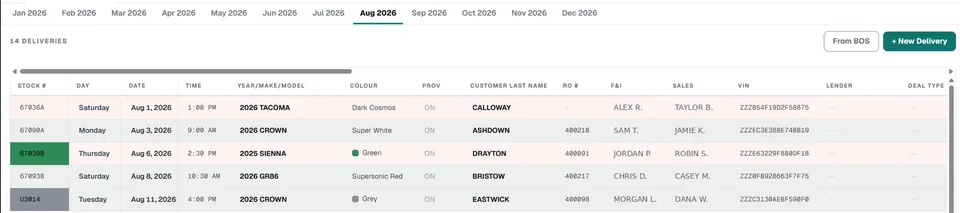
The real board. Synthetic data.
The board
The board tells the truth in colour. Green means genuinely ready, every prep step done, not "someone said it's fine." Amber means slipping. Red means the customer is already feeling it. Nobody interprets, nobody phones around, nobody asks "is it ready" because the answer is on the wall of every screen in the building.
Every role in its own lane
The application defines roles that match real dealership functions. Reps see only their own deliveries. Prep sees prep. Parts sees parts. Managers see everything, including automatic flagging of deliveries at risk of running late. Each role edits only what belongs to it, and that restriction is enforced in the database itself, not by politeness.
Notifications that respect people
The rep hears when their car is ready or slipping. The detailer hears when a delivery is created. The manager hears about delays. Nobody hears about everything, so nobody learns to ignore the noise.
Management sees the store
The whole board, every department, with deliveries at risk of running late flagged automatically. A complete history of who did what and when on every car, an append-only record nobody can quietly edit, and exports when the month-end conversation needs numbers on the table. Fewer surprises, shorter meetings, and the CSI conversation grounded in what actually happened.
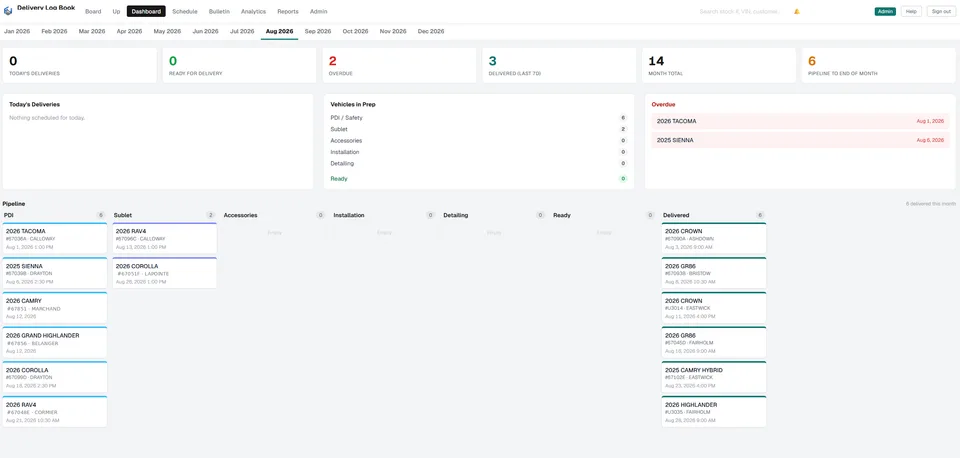
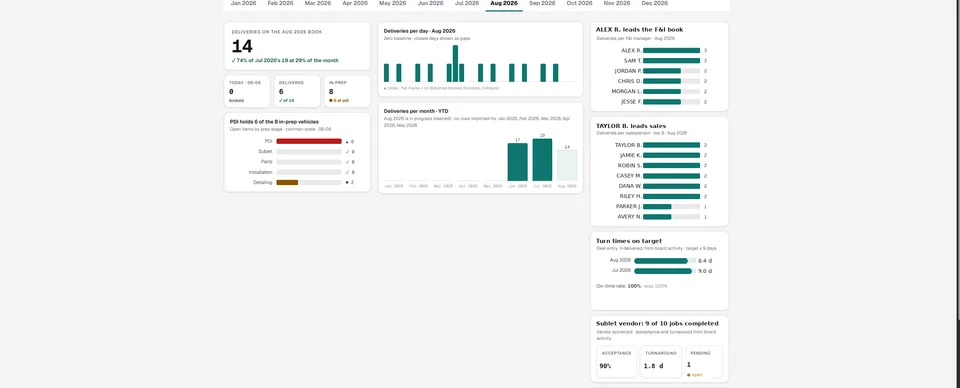
Manager dashboard and month report. Synthetic data.
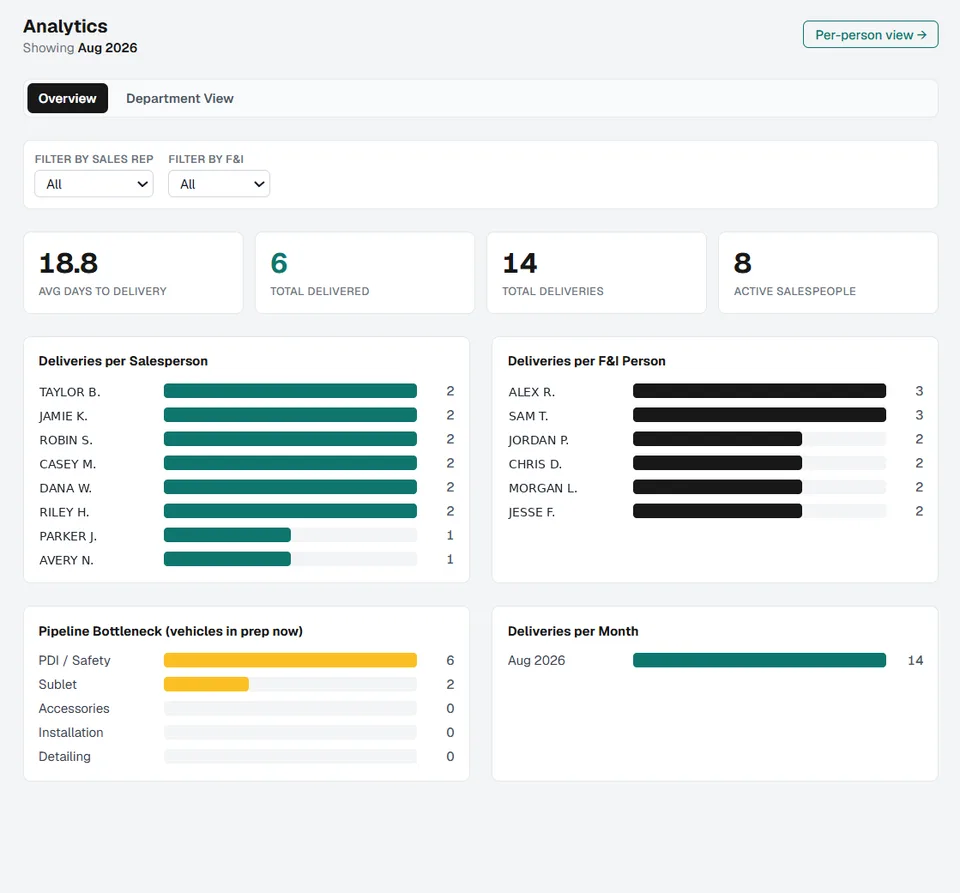
The analytics view. Synthetic data.
The up-board
The sales-to-F&I handoff is where deals wait and gross dies, and in most stores it runs on a verbal "who's up next." Delivery Book replaces it with a managed turn-over: each handoff is offered, accepted and closed as a recorded event. The rotation is fair and visible, every handoff has a record of who offered, who took it and when, and the disputes a whiteboard rotation invites simply end. There's a clock on it too: a customer sent to finance can't sit forgotten. If a manager doesn't take them in ten minutes, the system moves them to the next one and tells the rep exactly where their customer stands.
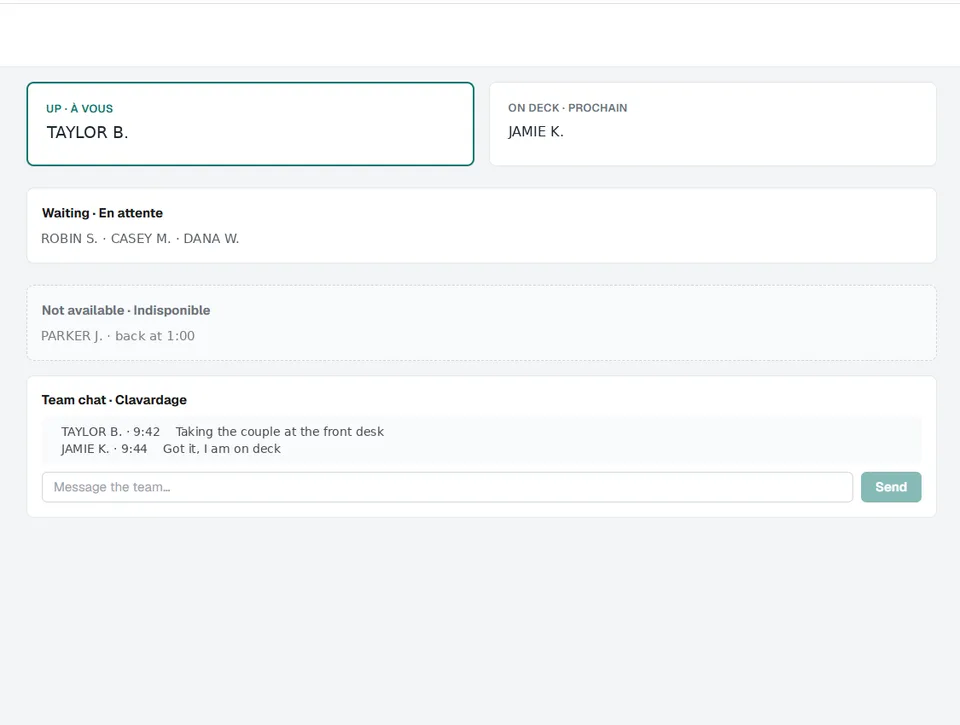
The up-board. Synthetic data.
Discovery travels with the customer
When the rep sends a customer to finance, a few structured answers travel with them. How long they're keeping the car, how they use it, who else drives it. F&I opens the conversation already knowing the customer, and the office time drops.
The calendar knows the store
A delivery booked at 2 p.m. is a promise made by the whole building, so the calendar checks the building before it lets you make it. The Delivery Calendar is availability-aware: it knows each person's schedule, so a delivery can't be booked on a rep's day off, on top of another delivery, or into a slot the store can't actually staff. Conflicts surface at booking time, when they cost nothing, instead of on delivery day, when they cost a customer.
Representative booking check. Synthetic data.
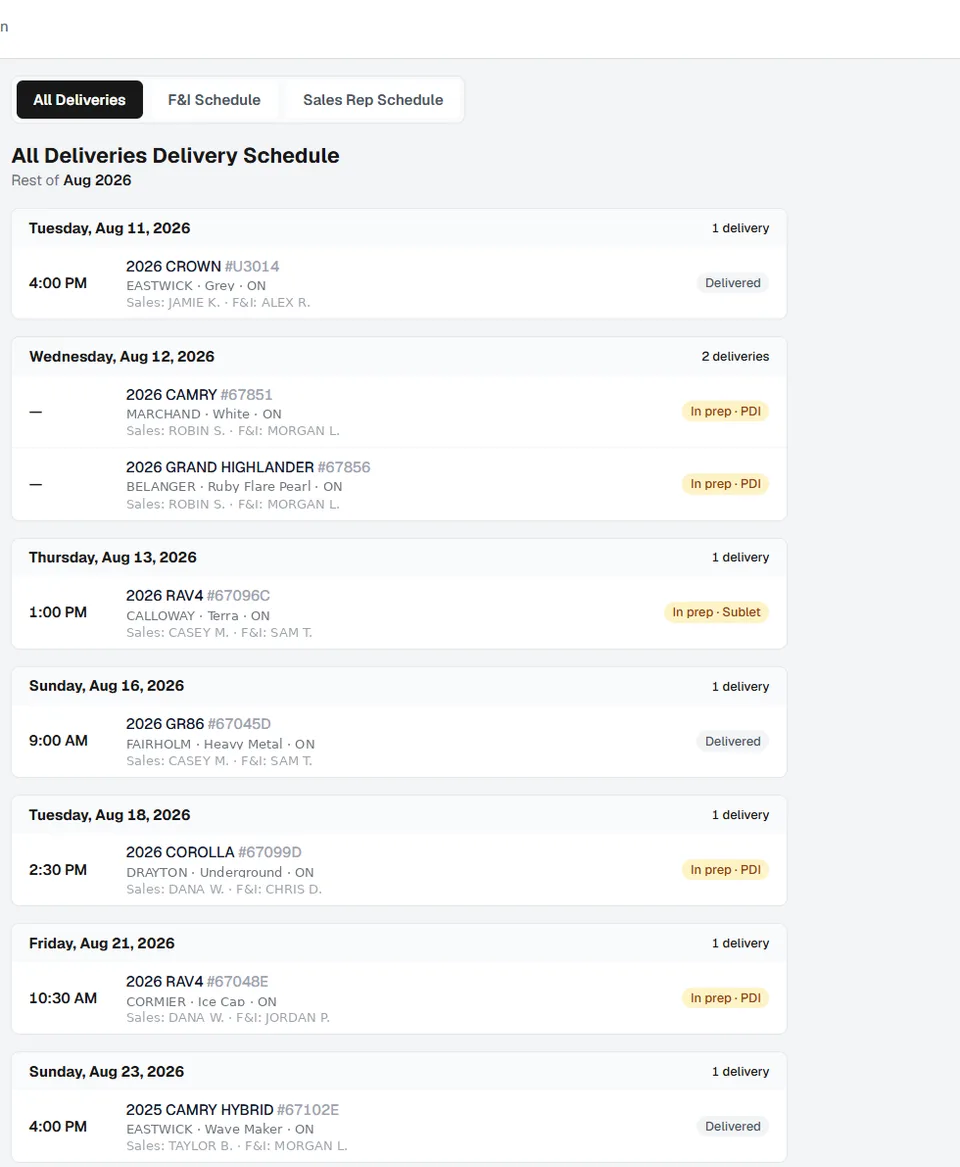
The schedule view. Synthetic data.
Read from the paperwork, stored nowhere
Staff don't re-key the deal. The bill of sale PDF is read entirely in the browser to pre-fill the delivery form, and the document itself is never uploaded, never stored, never retained. Only the structured fields a person would have typed reach the board, and the person reviews every field before saving.
Your team learns it fast
The board works the way the store already thinks, so most people need minutes, not sessions. Built-in help in English and French walks every role through its own lane, and short training videos cover each role's day. Onboarding a new hire is an invite email and a first delivery.
See the live board in fifteen minutes.
Book the fifteen minutes